
Ironstar Meridian
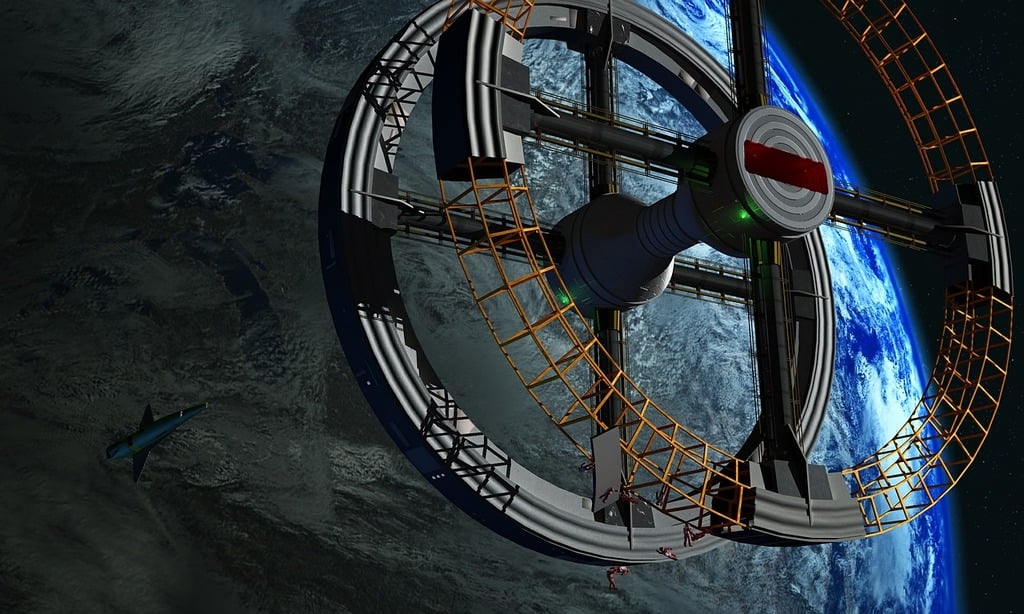
Humanity's orbital gateway. Every deep-space mission, cargo run, and research expedition stages through Ironstar Meridian — the last stop before the outer planets and the anchor point for Earth's first space elevator.
Deep Space Staging
Every crewed mission beyond Earth orbit stages through Ironstar Meridian. Crew rotation, cargo manifesting, mission planning. The last stop before the outer planets.
Asteroid Mining Operations
Coordinating robotic mining fleets across the inner belt. Processing rare earth elements and platinum-group metals that fuel the expansion economy.
Orbital Research Labs
Microgravity materials science, pharmaceutical crystallisation, and quantum computing research. Breakthroughs that can only happen at zero-g.
Solar System Communications
Operating the deep space relay network. Real-time comms to the Moon, 4-minute delay to Mars, 48-minute relay to the Jovian system.
Full-Stack Telemetry
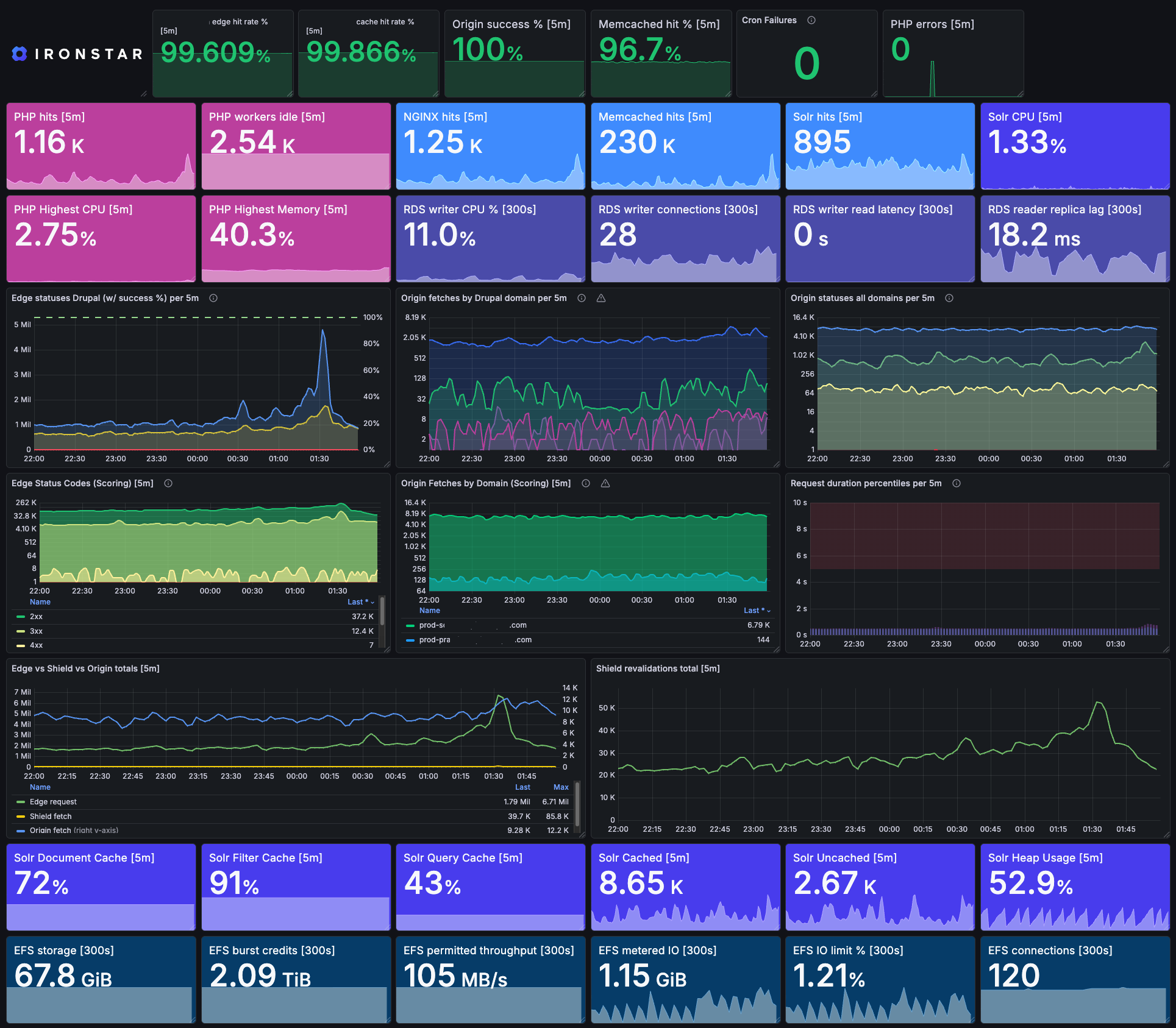
Every system on Ironstar Meridian is instrumented. Real-time dashboards track edge cache performance, origin health, database load, search engine throughput, and storage I/O across the entire platform stack — from the CDN edge to the application core.
During peak traffic events, the platform's multi-layer caching architecture absorbs millions of requests at the edge while maintaining near-zero origin load. The dashboard below shows a live customer site during a major traffic event — 99.6% edge hit rate, 100% origin success, and CPU utilisation under 3%.
Earth's First Space Elevator
Anchored to Ironstar Meridian at geostationary orbit, the elevator stretches 36,000 kilometres from an equatorial ground station to our orbital counterweight. It's the most ambitious engineering project in human history — and it's under construction now.
The tether is built from next-generation carbon nanotube composites reinforced with graphene polymers, achieving tensile strengths previously thought impossible. Every metre of cable is manufactured in our orbital labs, where microgravity enables molecular-level precision in materials fabrication.
When complete, the elevator will reduce the cost of reaching orbit by 98%, opening space to everyone — not just governments and corporations, but researchers, builders, and pioneers. This is how we democratise access to the solar system.
Jovian 6 Research Station
Ironstar's furthest permanent outpost. Jovian 6 orbits Europa in the Jovian system, operating as a crewed research platform for astrobiology, ice-shell geology, and subsurface ocean exploration. Every resupply mission and crew rotation is staged through Ironstar Meridian — a 48-minute relay delay that makes Jovian 6 the most remote crewed facility in human history.
The station supports a rotating crew of 12 researchers working on long-duration assignments. Its primary mission is the investigation of Europa's subsurface ocean for biosignatures, alongside materials science experiments leveraging the unique radiation and gravitational environment of the Jovian system.

Building humanity's infrastructure, from the ground to geostationary orbit
Drupal 11.4.5